
Floridians have called them sand flies for generations. In South Florida they emerge from the mud of mangrove swamps and salt marshes, bite hardest around dawn and dusk, and are small enough to slip through standard window screen.1,2 A 1979 state monograph, The Sand Flies (Culicoides) of Florida, described these biting midges as probably second only to mosquitoes for the discomfort they cause in Florida, and credited them with slowing the development of some parts of the state for tourism and housing.3
Figuring out how to get rid of no-see-ums in South Florida starts with that biology. The midges biting on a Fort Lauderdale patio or a Marco Island lanai often grew up in tidal mud the homeowner doesn’t own and couldn’t alter without a permit, then flew in on a still morning or evening. For coastal properties in South Florida no-see-um control focus may shift more to the adults of the species: keeping them out of the house, keeping them off people, and treating the landscaping they move through on the way in.
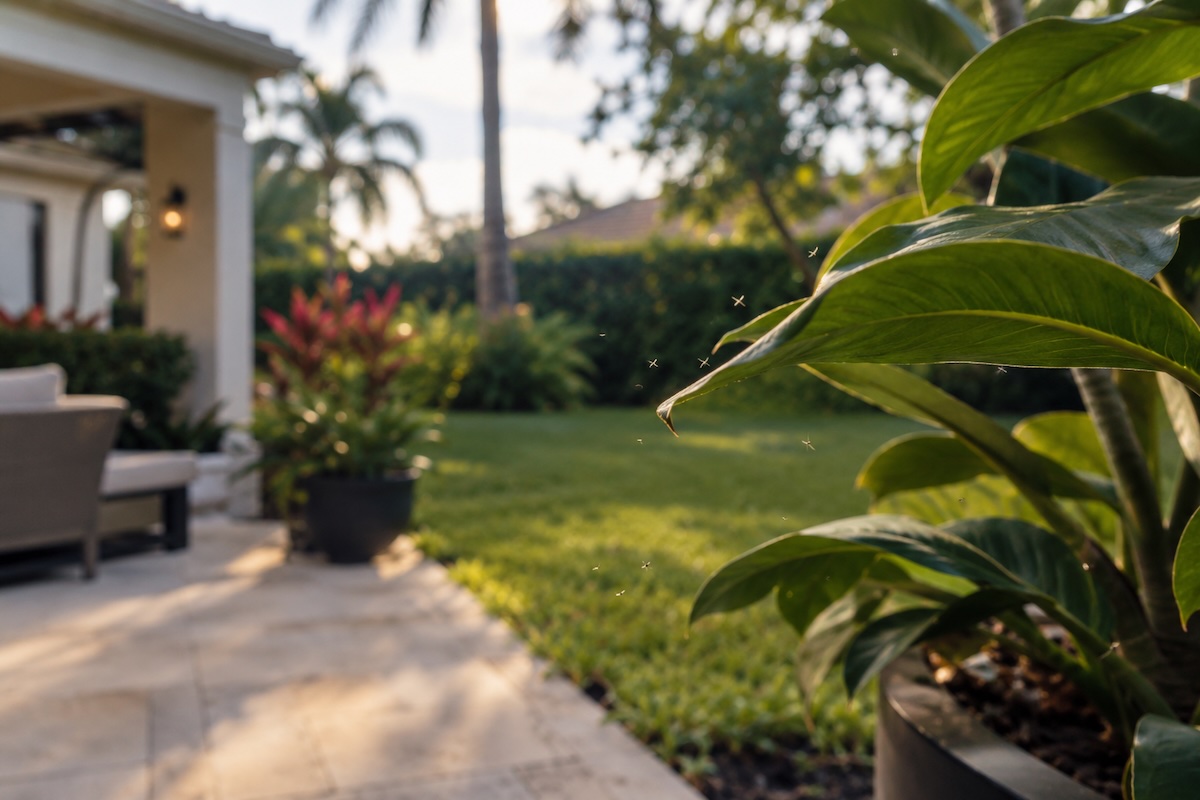
What Are No-See-Ums?
No-see-ums are biting midges, tiny two-winged flies in the family Ceratopogonidae. The species that bite people in Florida belong mainly to the genus Culicoides, which includes dozens of species in the state, and they also go by sand flies, sand gnats, and punkies.1,2 Photographed beside a penny, a Culicoides furens is about the size of Lincoln’s bow tie.2 Coastal residents often feel a bite and find no culprit, or only a speck on the skin, which is naturally how the name stuck.1
As you can see in the photo below, under magnification, an adult is gray, with dark and pale spots on its wings that entomologists use to tell the species apart.1,2 At rest, it folds its wings over its abdomen like a closed pair of scissors.1

xpda, CC BY-SA 4.0, via Wikimedia Commons
Both sexes of the species drink nectar for energy, but only females bite, because they need protein from blood to develop their eggs.1,2
A female no-see-um cuts the skin with toothed mandibles, injects saliva that keeps the blood from clotting, and drinks from the tiny pool that forms, a meal that takes a few minutes.1 The bite usually starts as a sharp sting or burning spot and becomes a small red welt. The discomfort typically lasts minutes to hours, though people who are hypersensitive to the bites can itch for days.2
How No-See-Ums Are Similar to Mosquitoes
No-see-ums and mosquitoes are both true flies, and in both groups only the female takes blood, which she uses to produce eggs.1,2 Both locate people by the carbon dioxide in their breath and by body heat. In Florida field trials, traps baited with carbon dioxide and octenol, a common insect attractant, caught mosquitoes and the coastal midge Culicoides furens together, and adding heat to the traps increased catches of both.4

Dunpharlain, CC BY-SA 4.0, via Wikimedia Commons
They also share South Florida’s coastline. The black salt marsh mosquito, Aedes taeniorhynchus, lays its eggs on moist soil in brackish coastal marsh, where flooding triggers the hatch, and the species accounts for a large share of the mosquito insecticide applications made in Florida.5 Coastal no-see-ums develop in the same mangrove and salt marsh mud, so a home on a Key Largo canal or along Biscayne Bay can get both from one shoreline.2
How No-See-Ums Differ from Mosquitoes
The two groups part ways in the larval stage. Mosquito larvae swim in standing water. No-see-um larvae are slender, worm-like, and only semi-aquatic. They live in saturated mud and the soggy edges of marshes, streams, and ponds, and they die if that habitat dries out.2
The adults differ as well. Midges are weak fliers in a breeze, though many species can travel more than a mile from where they emerged.2,6 The black salt marsh mosquito has a long flight range that can carry it far inland.5 And because midges pass through standard window screen, a screened house that keeps mosquitoes out can still let no-see-ums in.2
| Trait | No-See-Ums | Mosquitoes |
|---|---|---|
| Family | Ceratopogonidae (biting midges) | Culicidae |
| How females feed | Toothed mandibles cut the skin, and the female drinks from a tiny pool of blood | A slender proboscis pierces the skin to draw blood |
| Where the young develop | Saturated mud and the soggy edges of marshes, streams, and ponds | Standing water, from flooded marsh to backyard containers |
| Flight | Weak in a breeze, though many species travel more than a mile | Varies by species; the black salt marsh mosquito ranges far inland |
| Standard window screen | Passes through | Blocked by intact screen |
| Main concern in Florida | Painful nuisance bites; some species carry livestock viruses | Nuisance bites plus dengue and West Nile virus |
Health concerns differ too. Mosquitoes spread the locally acquired dengue and West Nile virus infections that the Florida Department of Health tracks in weekly reports, and the state’s locally acquired dengue cases in 2026 have included some in Miami-Dade, Broward, and Palm Beach counties.7 In the United States, no-see-ums are primarily a nuisance to people, and the chief medical issue is allergic reaction to their bites, though some species transmit bluetongue and epizootic hemorrhagic disease viruses to deer, cattle, and sheep.2,6
The Biology of No-See-Ums in South Florida
South Florida’s shoreline suits coastal no-see-ums well. Entomologists at the University of Florida’s Institute of Food and Agricultural Sciences (UF/IFAS) describe several species that develop in the marshes, swamps, and mangroves of Florida’s coast, where they can become numerous enough to send even seasoned outdoor people inside.2 The 1979 monograph found sand flies most numerous at freshwater inlets on the coast and along the streams that feed them.3
Midges that breed in water-filled tree holes are common in north Florida’s hardwood forests but uncommon or absent in South Florida, where such forests are scarcer. In the South Florida interior, other species are adapted to prairies and develop in low, sunny grasslands and marshes, the kind of country along the Everglades west of Miami, Fort Lauderdale, and Wellington.2
The Species Behind South Florida’s Bites
A UF/IFAS extension fact sheet ranked Florida’s four most important biting midge pests, all coastal species, in this order: Culicoides furens, C. mississippiensis, C. hollensis, and C. barbosai.1 In a year-long survey of Southwest Florida mangroves, furens and barbosai were the most prevalent species.8 Other species breed inland, and a second genus turns up along parts of the southeast coast.
Culicoides furens
Florida’s top-ranked biting midge pest, found along the coast statewide.1,9 Its larvae develop in mangrove and marsh mud, and the Southwest Florida survey recovered them from black mangrove areas.2,8 Its eggs hatch within a few days in warm weather, and a female lays 50 to 110 of them per blood meal. Some females produce a first batch without biting at all.1,2
Culicoides barbosai
A mostly tropical species found throughout the Caribbean, it occurs in Florida mainly in the coastal marshes of South Florida.9,10 In Florida it turns up around mangrove swamps, brackish tidal marsh, and coral, coquina, and sand beaches.10 In the Southwest Florida survey, its larvae came from red mangrove areas from May through July and from black mangrove areas from September through December, and adults were most active at dawn and dusk, with a much larger dawn peak.8
Culicoides insignis and Other Prairie Species
C. insignis, a tropical species whose Florida range extends into the southern part of the state, develops in wet pasture, prairie, and grassland, as do several other inland species.2,11 Its larvae have been associated with cattle operations, where the mud appears to suit their development.11
Leptoconops Midges
A second genus of biting midges, found in some coastal areas of southeast Florida as well as the Caribbean and the tropics. Leptoconops species can feed during daylight hours.6
The No-See-Um Life Cycle
A female lays her eggs on wet mud or other moist ground, and they typically hatch within a few days. The eggs die if they dry out, though in many species they can lie dormant for months until temperature and moisture are right.2 The larvae look like tiny pale worms. They feed on microscopic life such as nematodes and bacteria, breathe through their body wall, and pass through four growth stages, usually within about two weeks.2
A brief pupal stage follows in the same mud, and then winged adults emerge. Females that find a blood meal generally lay their eggs within about a week, starting the cycle again. With development this fast and breeding grounds that cover miles of shoreline, coastal midges keep emerging through the warm months.1,2
Weather shifts the numbers. Midge females lay eggs in muddy soil and can’t deposit them on top of standing water, so a summer wet enough to flood the breeding mud can mean fewer midges that fall. UF/IFAS entomologists predicted that after the heavy rains of 2005.9
No-See-Ums in Miami-Dade & Broward
Mangrove shorelines run along much of southern Biscayne Bay, from Matheson Hammock and the Deering Estate south to Black Point and Homestead Bayfront Park, and they line the Oleta River at North Miami Beach and parts of Key Biscayne. That tidal mangrove mud is the kind of habitat where C. furens and C. barbosai develop.2,8 Bayfront and canal-front homes in Coral Gables, Palmetto Bay, and Cutler Bay sit within flight range of that shoreline.
In Broward, West Lake Park and the Anne Kolb Nature Center protect a large mangrove estuary along the Intracoastal Waterway in Hollywood. Farther west, the suburbs end at the Everglades. Weston and Parkland border Everglades marsh and wet prairie, the low, sunny habitat UF/IFAS associates with interior species, and the muddy margins of retention lakes in Pembroke Pines and Miramar can suit species that breed at pond edges.2
No-See-Ums in Collier County
On the Gulf side, Naples wraps around the mangrove-lined Gordon River and Naples Bay, with the larger mangrove estuary of Rookery Bay National Estuarine Research Reserve to the south. Past Marco Island, the Ten Thousand Islands spread into a maze of mangrove keys around Everglades City and Chokoloskee, much of it protected within Ten Thousand Islands National Wildlife Refuge and Everglades National Park.
The Southwest Florida mangrove survey, conducted just north in Lee County, found C. barbosai and C. furens present from May through mid-December, with several peaks of abundance.8 In 2024, the Collier Mosquito Control District’s deputy director described the salt marsh midges familiar from the beach as more abundant in Collier County than the species that breed in hardwood forests.12
No-See-Ums in Palm Beach County
The Lake Worth Lagoon, an estuary that runs about 20 miles from North Palm Beach to Ocean Ridge, lines much of the county’s coast behind the barrier islands.13 It opens to the Atlantic through inlets at Palm Beach and Boynton Beach. Farther north, the Loxahatchee River winds through mangroves to Jupiter Inlet, where freshwater meets the sea in the kind of setting where the 1979 monograph found sand flies most numerous.3
In western Palm Beach County, Wellington and Loxahatchee Groves pair horse farms and pasture with the northern Everglades. That mix of wet pasture and marsh matches the inland habitats UF/IFAS lists for prairie-breeding species such as C. insignis.2
Biting midges also affect animals. Their bites can trigger sweet itch, an allergic skin condition in horses, and C. insignis is one of two confirmed U.S. carriers of the bluetongue and epizootic hemorrhagic disease viruses, which affect deer, cattle, and sheep.2
No-See-Ums in the Florida Keys
Few homes in the Keys sit far from tidal shoreline. Mangroves fringe the islands from Key Largo to Key West, and canal neighborhoods in Key Largo, Marathon, and Big Pine Key carry that shoreline into backyards. The mangroves and coral-sand beaches are the kinds of places C. barbosai turns up in Florida.10
Mosquito control in the Keys comes from the Florida Keys Mosquito Control District, whose service area stretches from Cross Key and Broad Creek to Key West.14 Florida’s mosquito control districts center their operations on mosquitoes, and a 2026 study of coastal midge problems notes there’s no clear guidance yet for adding midge management to that work, so protection from no-see-ums on a Keys property falls largely to the owner.15
On Monroe County’s mainland, Everglades National Park meets Florida Bay at Flamingo. Even in the dry season, the park recommends repellent, head nets, or bug jackets, because mosquitoes and biting flies may still turn up at dawn and dusk.16
When No-See-Ums Bite in South Florida
South Florida’s midges can bite in any month, though the 1979 monograph found them generally fewer during the comparatively dry winter.3 Each of the main coastal species keeps its own calendar, and all three bite most around dawn and dusk.1,8
| Species | Peak Season | Peak Biting Hours |
|---|---|---|
| C. furens | Builds with the spring warm-up and stays abundant through summer; can persist through a South Florida winter | Dawn and dusk, with some biting through the night |
| C. barbosai | May through mid-December in Southwest Florida mangroves | Dawn and dusk, with a larger dawn peak |
| C. mississippiensis | February through April and late September through December; lowest in summer | Dawn and dusk, with some biting through the night |
Daytime biting is less common but picks up under heavy overcast with calm winds.1 The 1979 monograph also singled out warm, moonlit nights, and UF/IFAS notes that during cold weather many species will bite in broad daylight.2,3
What Attracts No-See-Ums to an Area and How to Repel Them
No-see-um pressure can change from one house to the next on the same street. On a residential island at Cedar Key, years of trapping found midge numbers varying sharply from one site to the next.15 Several factors shape how much biting a property gets: distance from breeding habitat, the breath and warmth of the people outside, lighting, and how still the air is.
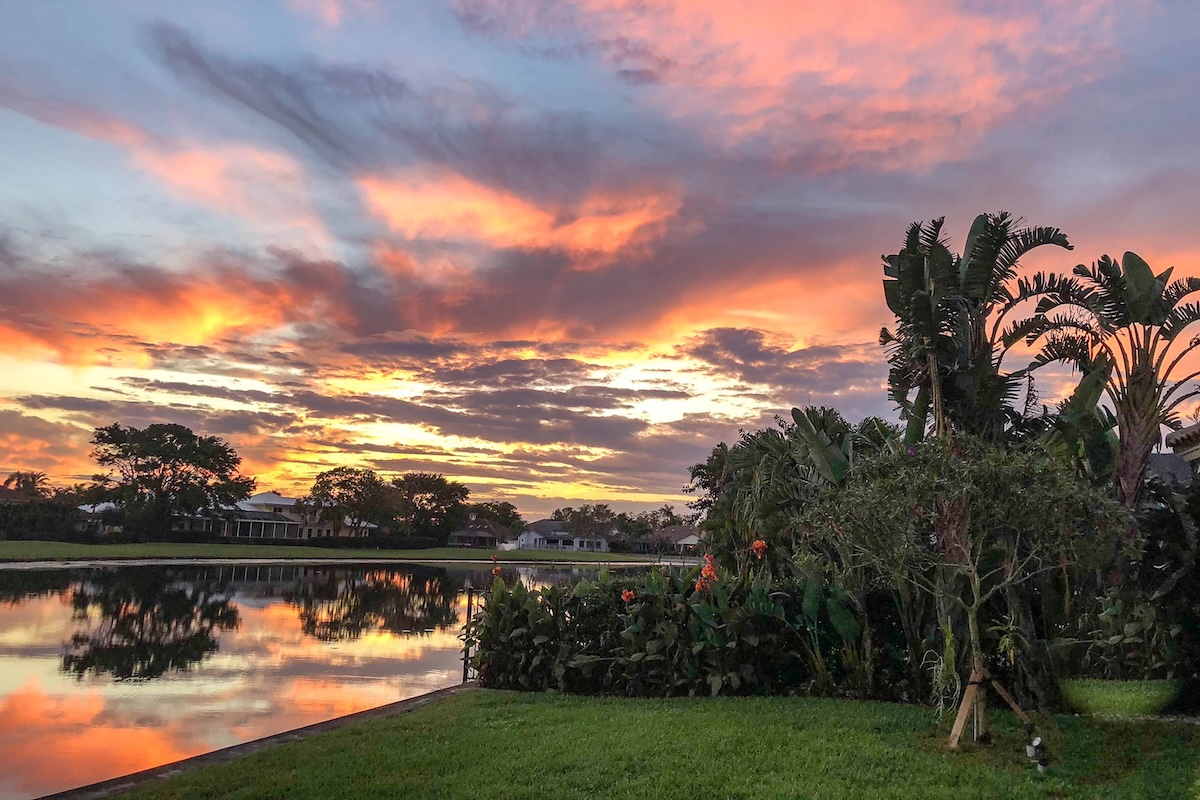
Biting midges are particularly abundant near mangrove swamps and salt marshes.1 A lanai facing the mangroves on an Islamorada canal or a dock on Naples Bay sits close to the source, and because many species fly more than a mile, homes several blocks inland can still get them.2 Wind exposure then raises or lowers the pressure, since midges fly poorly in moving air.6
Carbon Dioxide, Body Heat, and Skin Odor
Female midges are drawn to the carbon dioxide people exhale, to body warmth, and to compounds in human skin odor.4 In a statewide Florida trapping study, adding carbon dioxide to light traps increased catches of most Culicoides species.17 Near Cedar Key, researchers with the U.S. Department of Agriculture (USDA) found that pairing carbon dioxide with a synthetic blend of compounds identified from human skin raised C. furens captures 17.6 times over carbon dioxide alone.18
Outdoor Lighting
Light attracts midges. The same statewide study found that traps with ultraviolet LEDs collected more Culicoides species, and more midges overall, than traps with white incandescent bulbs.17 A 2025 report by Florida dermatologists in the journal Cutis notes that turning off porch lights helps, because no-see-ums are attracted to light.6 A bright fixture beside a screen door or over a lanai entrance at dusk can draw midges toward the openings people use most.
Calm Air and Sheltered Spots
Midges struggle in wind. The 1979 monograph found every Florida species most annoying when there’s no breeze.3 Sheltered spots, such as a courtyard enclosed by sea grape and hedges or a pool deck walled off from the prevailing breeze by dense landscaping, hold the still air midges favor.
How to Repel No-See-Ums Around Your Home
Because midges fly poorly in moving air and bite on a predictable daily schedule, small changes to airflow, timing, lighting, and clothing can cut bites on a screened lanai and an open dock alike.
- Move the air. No-see-ums are weak fliers, and fans set on high can reduce exposure.6 Outdoor-rated fans aimed across patio seating or a dock create the breeze midges struggle against.
- Plan around dawn and dusk. Scheduling yard work, dog walks, and time on the dock outside the morning and evening peaks avoids the hours coastal species bite most.1
- Rethink the lighting. Turning off or dimming porch and entry lights at dusk, and keeping bright fixtures away from doors and seating, gives midges less reason to gather where people are.6
- Cover up. Long sleeves and long pants protect skin that repellent might miss, and Everglades National Park recommends head nets or bug jackets for visitors.6,16
- Seat people in the breeze. Being outdoors on a windy day may lower the chance of being bitten, so on a breezy evening an open pool deck facing the water can be more comfortable than a sheltered courtyard.6
How to Eliminate No-See-Um Breeding Grounds
Breeding-ground control starts with sorting the wet ground you manage from the wet ground you don’t. On waterfront lots, the largest sources often sit off the property, in the tidal mud under mangroves and the salt marsh along the bays. UF/IFAS considers those larval habitats too extensive for larval control.1
Inland yards have more to work with. Some Florida species develop in the muddy edges of puddles and ponds, and others along stream edges.2 Because midge larvae and pupae can’t survive drying out, improving drainage can reduce the number developing in an area. UF/IFAS also notes the limits of that approach: in a California study, removing a wastewater pond complex thought to be a dairy-farm midge’s main breeding site didn’t reduce the adults.2
Breeding Sites You Can Fix on Your Property
Low spots that stay muddy for days after rain or irrigation are a good place to start. Regrading, adding drainage, or extending downspouts can let them dry between storms. Irrigation can keep beds and turf saturated too, so repairing leaks and shortening run times helps the soil surface dry out.
Ponds and retention lakes deserve a look at their edges. A pond ringed by a broad band of exposed mud can offer the kind of margin that pond-edge species use.2 In communities built around retention lakes, from Weston to Wellington, the banks are often common property managed by an association or district, so changes there go through that group.
Wet, decaying organic matter can host larvae too. The 2025 Cutis report lists saturated wood- and manure-enriched soil, rotting fruit, and water-holding plants among larval habitats.6 Keeping leaf litter, palm fronds, fallen mangoes, and manure on horse properties from piling up in damp spots reduces those habitats, and emptying containers and birdbaths and flushing bromeliads also cuts down on mosquito breeding.
Breeding Sites You Can’t Change
Mangrove shorelines are protected. Florida’s 1996 Mangrove Trimming and Preservation Act regulates how mangroves are trimmed and altered, and removing or defoliating them counts as alteration that requires a permit.19 Wetland rules limit broader habitat changes too, one reason UF/IFAS gives for the limited practicality of habitat modification against midges.2
The same holds for the salt marsh along the bays and the Everglades marsh and prairie beyond the western suburbs. Those habitats are public land, protected wetland, or both, and they produce midges on a scale no single property can change.
Trimming leaves the breeding mud in place, and state law limits it. Homeowners can trim shoreline mangroves without a permit or a professional mangrove trimmer when the trees grow in a riparian mangrove fringe, a band no more than 50 feet deep, and stand taller than 6 feet but no taller than 10 feet, provided they aren’t defoliated or cut below 6 feet. Taller trees call for a professional trimmer, a permit, or both. Miami-Dade and Broward counties administer these rules locally under authority delegated by the state.19
How to Block No-See-Ums from Entering Your Home
Indoors, no-see-ums are visitors. Their larvae need saturated mud or similar wet ground, so the midges biting inside a house typically came in through a screen or an open door.2 Standard window screen won’t stop them, and UF/IFAS photographs show C. furens passing through it. Screen made for no-see-ums uses a tighter weave, commonly 20×20 mesh, meaning 20 strands per inch in each direction, and UF/IFAS describes its openings as small enough to exclude biting midges.2,20
Manufacturers make no-see-um screen for porches and pool and patio enclosures.20 The tighter weave cuts some airflow, a tradeoff the 2025 Cutis report notes, and moving air also deters midges.6 Choosing where to use finer screen weighs protection against comfort, especially on a large screened pool enclosure in Coral Springs or Naples. A separate resource about no-see-um control for South Florida homes/patios covers enclosure inspections in more detail.
Upgrade screens on the water-facing side
Replace standard screen with 20×20 no-see-um mesh on the porch, lanai, or pool-enclosure panels nearest the mangroves, canal, or lake, and on windows and doors where rescreening is practical.
Close the gaps
An insect small enough to pass through window screen also slips under doors, around loose screen frames, and through small tears. Door sweeps, weatherstripping, and prompt screen repairs shut those routes.
Close up at dawn and dusk
Keeping doors and windows shut during the morning and evening peaks, and letting the air conditioning handle cooling, keeps midges out during the hours coastal species bite most.1
Keep air moving in screened rooms
UF/IFAS recommends high-velocity fans on screened porches.1 Ceiling fans over a lanai’s seating area put that breeze where people sit.
Treat screens for short-term relief
UF/IFAS notes that treating screens with an insecticide spray or portable fogger, used according to the label, can bring temporary reductions in small backyard settings.1
How to Use Targeted Repellents and Traps for No-See-Ums
Repellents protect the person wearing them, while traps and yard treatments work on the midges around a property. Both have a role in South Florida, and the research on each points to different strengths and limits.
For a sunrise launch at Black Point Marina or an evening on a Key West dock, repellent on exposed skin and long sleeves protect a person directly. Around a home, traps and vegetation treatments can lower the number of midges, though new ones keep arriving from nearby breeding sites.1
Repellents Labeled for No-See-Ums
DEET is the main repellent ingredient used against biting midges.2 Picaridin is another option, and the 2025 Cutis report notes that repellents containing either one can protect exposed skin. The same report says oil of lemon eucalyptus, or its active ingredient PMD (p-menthane-3,8-diol), has been shown effective against no-see-ums.6
Labels that list no-see-ums or biting midges often give a separate protection time for them, which can differ from the mosquito figure. One 20% picaridin repellent registered with the U.S. Environmental Protection Agency (EPA) in 2025 lists 12 hours of protection from mosquitoes and ticks and 8 hours from no-see-ums.21 Reapplication limits and age restrictions vary by product and appear on each label. Repellent protects only the skin it covers, so ankles, necks, and hairlines need coverage too.
Carbon Dioxide Traps
Traps that release carbon dioxide, often with octenol or heat, catch enormous numbers of no-see-ums. In one year-long evaluation of two propane-powered commercial traps, researchers collected more than 35 million Culicoides, mostly C. furens, C. barbosai, and C. mississippiensis.22
Whether trapping protects the people in a yard is a separate question, and field tests show mixed results. In a residential study at Cedar Key, on Florida’s Gulf Coast, yards with a propane trap did have less midge pressure than untreated yards, and yards that paired a trap with a barrier treatment, an insecticide applied to the vegetation where biting insects rest, did better than those.23
On Key Island, the barrier island just south of Naples, researchers ran a line of 52 baited traps to protect a resort area from salt marsh mosquitoes. Mosquito numbers in the resort did drop while the line operated, however, the reduction ultimately fell short of statistical significance.24
Barrier Sprays on Vegetation
In the same Cedar Key study, yards treated with bifenthrin, a pyrethroid insecticide, had less midge pressure than untreated yards whether or not a trap was running, and the researchers suggested that barrier treatment alone may be enough to suppress midges.23 Pyrethroids are synthetic relatives of pyrethrins, the natural insecticide found in chrysanthemum flowers, and together they form the main insecticide class used against blood-feeding flies, including biting midges.2
Recent Florida testing found that a permethrin product applied as an ultra-low-volume fog, which disperses insecticide as a fine aerosol, killed all of the field-collected C. furens tested.2 The effect is short-lived, though. New midges keep emerging from breeding habitat, which is why UF/IFAS describes spray control of adult midges as temporary.1
Automatic Misting Systems for No-See-Ums in South Florida
For homes and businesses within flight range of mangroves, tidal marsh, or an inlet, installing an automatic misting system is the most complete long-term answer to no-see-ums. It’s the only measure covered here that applies insecticide around the property on a daily schedule, timed to the dawn and dusk flight windows, without anyone having to remember. That schedule matches the problem UF/IFAS describes: adult midges emerging continually from breeding grounds too extensive to treat.1
Products often used in misting systems contain pyrethrins or permethrin, the same insecticide family behind the barrier and fogging results above, and some also contain piperonyl butoxide.25 A properly calibrated system applies no more than the label’s daily maximum, in small doses timed to the hours midges fly.25
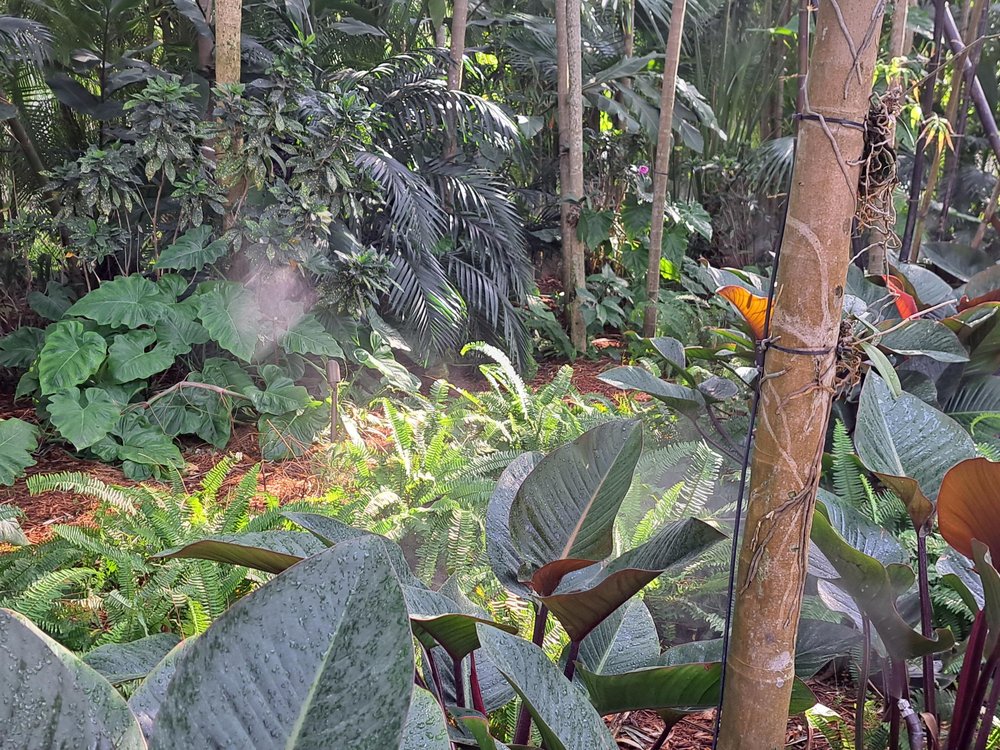
EPA considers integrated pest management, a combination of control methods, the most effective way to manage mosquitoes, and it notes that residential misting systems haven’t yet been studied enough to document their effectiveness against mosquitoes or other yard pests.25 For no-see-ums, that combination looks like the layers covered above: tighter screens, moving air, labeled repellent for time away from home, and a misting system working the perimeter of the yard.
How an Automatic Misting System Works
A misting system is a network of spray nozzles mounted around a property’s perimeter, in landscaping, along fences, or on the house, connected by tubing to an insecticide reservoir. Many systems run on a timer at preset intervals, and some can also be switched on by remote.25
The equipment, controls, and service are covered in detail in this guide to automatic mosquito misting systems for South Florida properties. For no-see-ums, a system’s performance depends on three design choices: the schedule, where the nozzles point, and how the layout accounts for wind.
Designing a Misting System for No-See-Ums
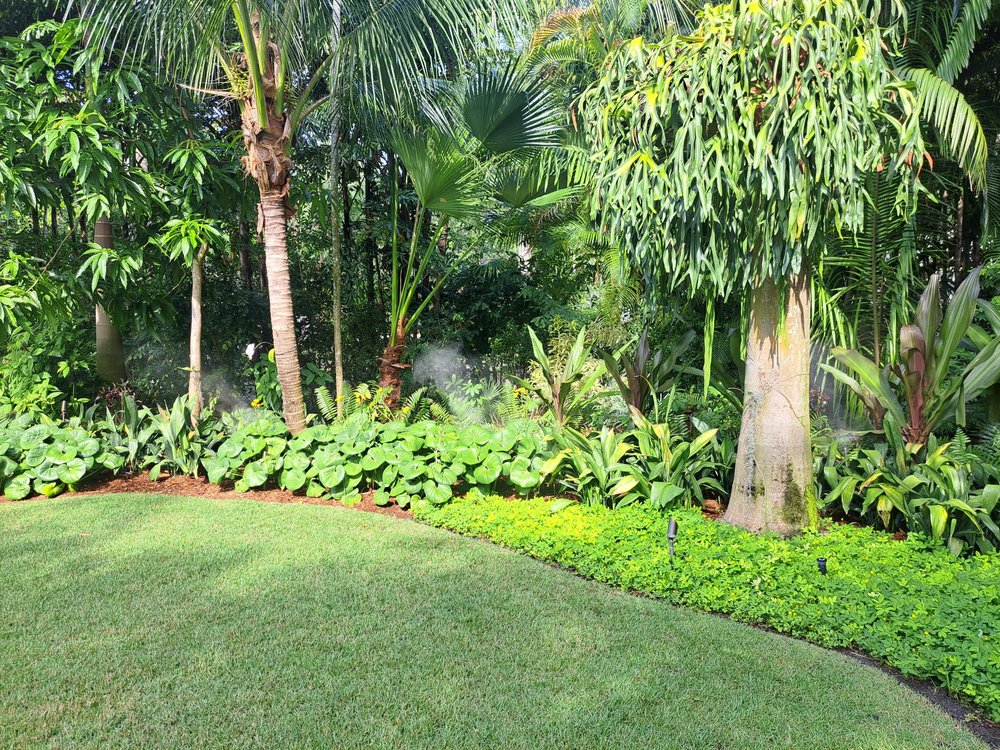
The schedule is the first of those choices. EPA advises running a system when pests are most active and setting timers for times when people and pets are unlikely to be in the spray zone.25 For coastal no-see-ums, that points to cycles around sunrise and sunset, the peak biting hours for Florida’s coastal species, and where C. barbosai is common, its larger dawn peak makes the morning cycle a priority.1,8
Nozzle placement follows the route midges travel. Aimed into the landscaping between the breeding habitat and the living area, nozzles can treat the zone midges cross on their way to people. EPA recommends keeping nozzles under 10 feet high to reduce drift; aiming mist away from eating and cooking areas, air conditioner intakes, and any water, including pools and fish ponds; and adding wind, rain, and motion sensors where practical.25
EPA also notes that permethrin is toxic to fish and that pyrethrins and permethrin can kill other insects such as honeybees and butterflies, so it’s advised to place nozzles away from parts of the property where this would be an issue.25 Many South Florida properties sit on the water, from Fort Lauderdale’s canals to Marathon’s bayfront, so nozzle aim around docks and seawalls is part of the design.
Wind affects both the insects and the mist. A steady breeze off Biscayne Bay or the Gulf suppresses midge flight, and EPA advises against running a system in winds above 10 mph, in rain, or in fog.3,25 Calm mornings and evenings are when coastal midges fly and when mist is most likely to stay where it’s aimed. This overview of outdoor misting systems explains how coastal wind shapes nozzle placement.
In Florida, a UF/IFAS licensing guide places the installation and service of automated mosquito misting devices under a pest control operator’s license in the General Household Pest or Lawn and Ornamental category. These licenses fall under Chapter 482 of the Florida Statutes and are issued by the Florida Department of Agriculture and Consumer Services.26
Misting Systems for Restaurants, Marinas, and Community Amenities
A waterfront restaurant deck in Islamorada and a lakeside clubhouse in Wellington can face the same dusk problem from different breeding grounds, tidal mangrove mud for one and pond margins and nearby marsh for the other. Commercial system design applies the same biology to larger perimeters, with schedules built around service hours and guest traffic.
EPA’s consumer guidance on misting systems covers homes and doesn’t address restaurants or other public spaces, so commercial sites follow product labels and state rules.25 This page on commercial mosquito misting systems covers planning for restaurants, hotels, marinas, and homeowners associations.
Frequently Asked Questions About No-See-Ums in South Florida
Q: Do no-see-ums in South Florida carry diseases?
A: No-see-ums aren’t known to transmit disease to people in the United States.6 Oropouche virus, which midges spread in South America and the Caribbean, has turned up in Florida only in travelers, mostly people returning from Cuba, and none were reported in 2026 through early October.7,27 Its best-known midge carrier, Culicoides paraensis, breeds in tree holes in hardwood forest, a habitat that’s uncommon in South Florida, and the Collier Mosquito Control District’s deputy director has said there’s no evidence the salt marsh midges familiar from the beach can spread it.2,12
Q: How far can no-see-ums fly from the mangroves?
A: Farther than their size suggests. UF/IFAS reports that many biting midge species fly about 2 kilometers, or roughly 1.2 miles, and some species have been tracked farther.2 They fly poorly in wind, though, and breezy days tend to bring fewer bites.3,6
Q: Do no-see-ums breed in beach sand?
A: Some species do, in wet sand only. In a Florida study of a natural beach inside a coastal inlet, larvae and pupae of Culicoides melleus stayed within the intertidal zone, the band of sand the tide covers and uncovers.28 Dry sand above the tide line doesn’t support midge larvae, which die if their habitat dries out.2
Q: What time of year are no-see-ums worst in South Florida?
A: They can bite in any month here, though numbers generally drop during the comparatively dry winter.3 In Southwest Florida mangroves, the two dominant coastal species were present from May through mid-December, with several peaks.8
Q: How should a no-see-um bite be treated?
A: The 2025 Cutis report recommends washing the bite with soap and water, applying a cold compress, and avoiding scratching, with over-the-counter hydrocortisone cream or calamine lotion to ease the itch. Spreading redness and swelling, or signs of infection, are reasons to see a healthcare provider.6
South Florida’s no-see-ums come from mangrove mud, tidal marsh, and Everglades wetlands that no single property controls, and they fly on a schedule set by sunrise, sunset, and the wind. A misting system timed to those hours, backed by 20×20 screens, moving air, and labeled repellent, can keep a patio, pool deck, or dock comfortable at dawn and dusk.
Sniper Mosquito Solutions designs, installs, and services automated misting systems for mosquitoes and no-see-ums at homes and businesses across South Florida. For a free estimate, call (866) 447-6473 or contact the team online.
References
1. Rutledge CR, Day JF. Biting Midges of Coastal Florida. UF/IFAS Extension ENY-629 (revised 2005, reviewed 2008). View source
2. Burkett-Cadena ND, Cooper VM, Addae CA, Connelly CR, Buckner EA. 2025. Biting Midges, No-See-Ums Culicoides spp. (Insecta: Diptera: Ceratopogonidae). UF/IFAS EDIS EENY349/IN626. View source
3. Blanton FS, Wirth WW. 1979. The Sand Flies (Culicoides) of Florida (Diptera: Ceratopogonidae). Arthropods of Florida and Neighboring Land Areas, Vol. 10. Florida Department of Agriculture and Consumer Services. View source
4. Kline DL, Lemire GF. 1995. Field evaluation of heat as an added attractant to traps baited with carbon dioxide and octenol for Aedes taeniorhynchus. Journal of the American Mosquito Control Association 11(4): 454-456. View source
5. Black Salt Marsh Mosquito Aedes taeniorhynchus (Wiedemann) (Insecta: Diptera: Culicidae). UF/IFAS EDIS IN1035. View source
6. Sequeira EM, Sequeira MJ. 2025. Dermoscopic Documentation of a No-see-um Bite. Cutis 116(4): 127-128. View source
7. Florida Arbovirus Surveillance, Week 40: October 4-10, 2026. Florida Department of Health. View source
8. Kline DL, Roberts RH. 1982. Daily and Seasonal Abundance of Culicoides spp. Biting Midges in Selected Mangrove Areas in Lee County, Florida. Florida Entomologist 65(1). View source
9. Fewer Biting Midges Expected This Fall, Thanks to Summer Rains, Says UF Expert. UF/IFAS News, September 29, 2005. View source
10. Culicoides (Oecacta) barbosai Wirth and Blanton, taxonomic treatment. Zenodo. View source
11. Sloyer KE, Burkett-Cadena ND, Yang A, Corn JL, Vigil SL, McGregor BL, Wisely SM, Blackburn JK. 2019. Ecological niche modeling the potential geographic distribution of four Culicoides species of veterinary significance in Florida, USA. PLoS ONE 14(2): e0206648. View source
12. Collier Mosquito Control District nearly doubles in size. The Naples Press, October 11, 2024. View source
13. Lake Worth Lagoon Restoration. Palm Beach County Water Resources Task Force. View source
14. Mosquito Surveillance and Insecticide Resistance Monitoring Conducted by the Florida Keys Mosquito Control District, Monroe County, Florida, USA. Insects. View source
15. Lloyd AM, Kline DL, McKenzie KE, Hahn DA. 2026. Can Trapping Abundance Data Be Used to Identify Persistent Target Areas for Culicoides Biting Midge Control Efforts? Insects 17(6): 653. View source
16. The Dry Season. Everglades National Park, National Park Service. View source
17. Effects of Ultraviolet LED Versus Incandescent Bulb and Carbon Dioxide for Sampling Abundance and Diversity of Culicoides in Florida. 2019. Journal of Medical Entomology 56(2). View source
18. Kline DL, Bernier UR, Hogsette JA. 2012. Efficacy of Three Attractant Blends Tested in Combination with Carbon Dioxide Against Natural Populations of Mosquitoes and Biting Flies at the Lower Suwannee Wildlife Refuge. Journal of the American Mosquito Control Association 28(2). View source
19. Mangrove Trimming Guidelines for Homeowners. Florida Department of Environmental Protection. View source
20. Pool and Patio Screening. Phifer. View source
21. BUGGINS Insect Repellent X (20% picaridin), EPA Reg. No. 67867-8, registration notice and label, May 16, 2025. U.S. Environmental Protection Agency. View source
22. Lloyd AM, Kline DL, Hogsette JA, Kaufman PE, Allan SA. 2008. Evaluation of Two Commercial Traps for the Collection of Culicoides (Diptera: Ceratopogonidae). Journal of the American Mosquito Control Association 24(2): 253-262. View source
23. Lloyd AM, Kline DL, Bernier UR. 2021. Field Evaluation of Talstar (Bifenthrin) Residential Barrier Treatments Alone and in Conjunction with Mosquito Magnet Liberty Plus Traps in Cedar Key, Florida. Journal of the Florida Mosquito Control Association 68(1): 56-62. View source
24. Kline DL, Lemire GF. 1998. Evaluation of attractant-baited traps/targets for mosquito management on Key Island, Florida, USA. Journal of Vector Ecology 23(2): 171-185. View source
25. Mosquito Misting Systems. U.S. Environmental Protection Agency. View source
26. Harlow EE, Harlow LB, Haddock S, Bultemeier BW. 2025. Finding the Correct Pesticide Applicator License in Florida. UF/IFAS EDIS PI292. View source
27. Scientists are researching whether Florida insects could spread Oropouche. Florida Phoenix, November 13, 2024. View source
28. Ecology and behaviour of immature Culicoides melleus (Coq.) (Dipt., Ceratopogonidae). Bulletin of Entomological Research. View source
This article provides general information. Pesticide and repellent labels give the specific directions for each product, and a healthcare provider can advise on strong reactions to bites.